
What motherhood, faith, and a willingness to examine myself have taught me about belonging.
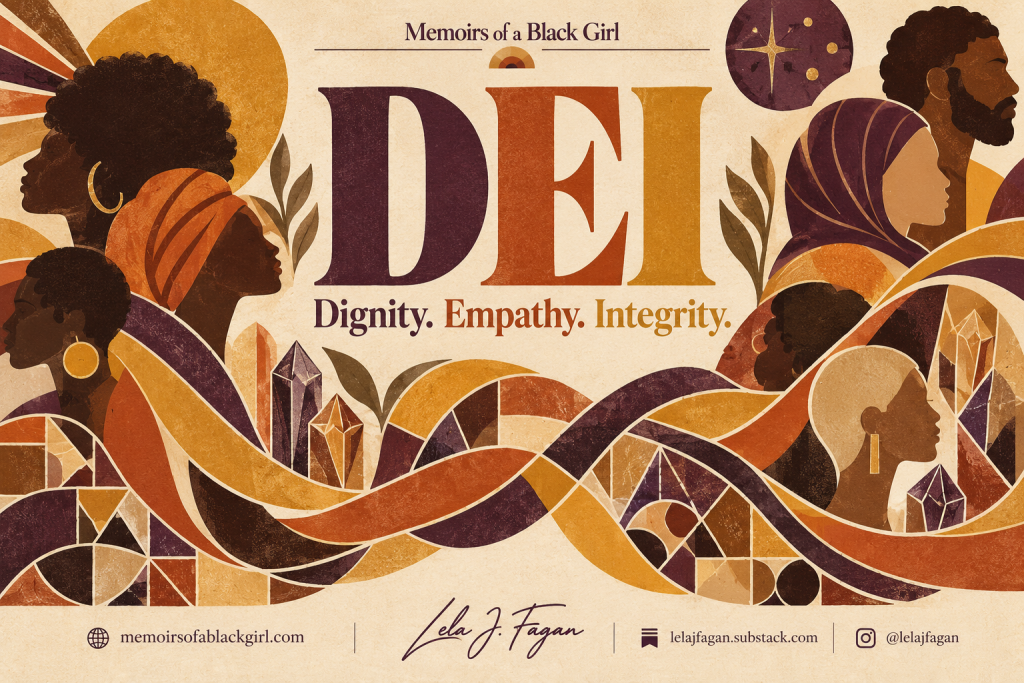
I propose we give DEI three more words to stand for:
Dignity. Empathy. Integrity.
The climate of communication across social media and media today has me thinking about how often we actually practice those three things.
I see how easily people dismiss those whose lives look different from their own. Prejudice becomes commentary. Fear of people from other countries becomes a talking point. Someone’s need for support becomes an accusation that they are receiving an unfair advantage.
And somewhere in all that noise, we stop seeing the person.
We see another shade of the rainbow and question why that person needs an opportunity, without considering the systemic barriers or generational challenges that may have shaped their journey.
I believe in equality. I also believe that understanding fairness requires us to look beyond our own experience.
Some obstacles are easy to overlook when you have never had to climb over them.
The learning starts with us
We have a responsibility to educate our children. We also have a responsibility to keep educating ourselves.
Me included.
Especially me.
It would be comfortable to write this as though I have always understood inclusion. As though I have always chosen the right words, recognized someone else’s needs, or responded with compassion.
But that would leave out the part where I have had to grow.
Becoming a mother to children with special needs changed how I understand inclusion. It required me to revisit my own assumptions, my own comments, and the ways I once treated people whose experiences I did not understand.
There are things I would say differently now. There are moments I would handle with more patience, more curiosity, and less judgment.
Would I have developed this same awareness if I had never become their mother?
I hope so. But honestly, I cannot say for certain.
What I can say is that my empathy has deepened because I live this every day.
Inclusion lives in the everyday
For our family, inclusion shows up in the adjustments we make, the expectations we reconsider, and the ways we help our children participate.
Every day, I am learning how to support children who think, communicate, and move through the world differently.
Sometimes that means changing how I give an instruction. Sometimes it means recognizing that a behavior is communicating something I need to understand. Sometimes it means celebrating progress that someone outside our household might not even notice.
Through it all, I want my children to see themselves fully.
I want them to know they are loved by Christ and wonderfully made. Their need for support does not diminish their worth. Their differences do not make them an unfinished version of somebody else.
Their gifts deserve room to grow. Their needs deserve attention. Their dignity should never depend on how closely they resemble someone else’s idea of “normal.”
And that understanding has to reach beyond my own household.
I explore that everyday practice of listening and making room for others in You’re a Person Too: Caring for Others and Yourself.
I should not have to share someone’s race, nationality, disability, or life story to care about how they are treated.
My experience can deepen my empathy. Someone else’s dignity should never have to wait for me to experience their struggle.
Dignity, empathy, and integrity in practice
Diversity, equity, and inclusion deserve thoughtful conversation. I want us to bring dignity, empathy, and integrity into that conversation, too.
Dignity asks us to recognize another person’s worth before deciding whether we understand their circumstances.
Empathy asks us to listen with enough humility to consider that our experience is not the only experience.
Integrity asks us to let those convictions shape our behavior—in person, online, and when nobody we know is watching.
It is easy to speak about kindness in the abstract. Practicing it becomes more demanding when someone needs an accommodation we have never needed, describes a barrier we have never encountered, or challenges an assumption we have carried for years.
That is where we have an opportunity to grow.
We can ask a better question. We can listen without preparing our rebuttal. We can admit that we did not understand something before.
I have had to do all three. I expect I will have to keep doing them.
Uniquely made, worthy of belonging
There are billions of people on this planet, and no two are exactly alike. Even identical twins have their own perspectives, personalities, and experiences.
We are snowflakes in that sense: uniquely designed, each beautiful in our own right.
Our differences give us something to learn from one another. They also call us to consider what another person might need to participate, contribute, and thrive.
Before we dismiss someone’s challenges or question whether they deserve a seat at the table, we can pause long enough to see the person.
A person with a history we may not know.
A person with gifts we have not yet recognized.
A person whose humanity is as complete as our own.
Dignity. Empathy. Integrity.
Those are values I want to practice, teach my children, and carry into every community I serve.
The work begins with how I see people—and continues with how I treat them.
— Lela J. Fagan
Globally I’m a world changer, locally I’m a village builder.
If this reflection resonates with you, share it with your village. You can also read the Substack edition and subscribe for more reflections on faith, family, and the everyday work of growing together.
memoirsofablackgirl.com
lelajfagan.substack.com
@lelajfagan
© 2026, Lela Fagan. All rights reserved.